
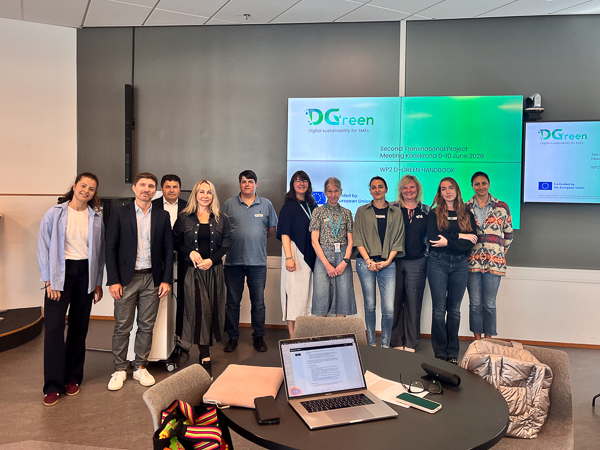
In June, representatives of Let's Do It World joined fellow partners of the Erasmus+ D-Green project at Blekinge Institute of Technology (BTH), Sweden. While the project aims to help SMEs become more digitally sustainable, one of the most valuable takeaways was a science-based framework that can benefit any organisation working towards long-term environmental change.
The Framework for Strategic Sustainable Development (FSSD) is used by businesses, municipalities, universities and organisations around the world to tackle complex sustainability challenges. Rather than focusing only on individual problems, it encourages organisations to look at the systems that create them, offering a practical way to move beyond short-term fixes towards lasting change.
For us, it provided valuable insights not only for D-Green, but also for the wider mission of Let's Do It World and the World Cleanup Day movement.
For more than a decade, World Cleanup Day has mobilised millions of volunteers to remove waste from nature across 211 countries and territories. Every cleanup demonstrates both the scale of the challenge and the power of collective action. But it also raises an important question: why does the waste keep coming back?
Waste is not simply a littering problem. It is shaped by the way products are designed, produced and consumed, as well as by infrastructure, education, legislation and economic incentives. Unless those systems change, cleanups will continue to address the symptoms rather than the causes.
The same principle applies to digital sustainability. Actions such as extending the life of devices or reducing unnecessary data are valuable, but lasting impact comes from changing the systems and behaviours that generate digital waste in the first place.
The Framework for Strategic Sustainable Development is built around four stages that help organisations move from reacting to problems towards creating long-term change.
The process begins by agreeing what success looks like. What future are we trying to create? What values should guide our decisions? By starting with these questions, organisations can define success before deciding what actions to take. For both World Cleanup Day and D-Green, that means looking beyond reducing waste today and working towards systems that generate less waste in the first place.
The next step is taking an honest look at the current situation. What impacts are we creating? Which activities support our vision, and which work against it? For World Cleanup Day, this means understanding not only how much waste is collected, but where it comes from and why it exists. Within D-Green, the same thinking applies to digital sustainability, encouraging organisations to examine areas such as device lifecycles, energy consumption, cloud storage and everyday digital behaviours.
With a clear understanding of the challenge, organisations can begin exploring solutions. Rather than focusing on constraints, the framework encourages participants to think boldly. What opportunities are we overlooking? Which ideas could eliminate most of the problem, rather than simply reducing it? This stage is about creating space for innovation before narrowing the options.
Not every idea should be implemented immediately. The final stage is about identifying the actions that will have the greatest long-term impact by asking three simple questions: Does this move us towards our vision? Does it create a platform for future improvements? And does it make good use of our time and resources? This helps organisations focus on strategic actions rather than short-term fixes.
One of the key messages of the D-Green project is that digital sustainability should not be viewed as a separate environmental issue. Digital technologies influence almost every aspect of modern life and business, so the challenge is no longer whether we use them, but how we use them.
The same systems-thinking approach that helps tackle physical waste can also reduce digital waste, improve resource efficiency, extend device lifetimes, lower energy consumption and support more resilient organisations. As D-Green develops practical tools, training materials and online learning resources for SMEs, this approach provides an important foundation. Digital sustainability is not simply about reducing digital waste – it is about redesigning how organisations use technology so that digital transformation supports both business resilience and planetary boundaries.
For World Cleanup Day, these ideas reinforce the direction in which the movement has already been evolving. Alongside organising cleanups, we now promote environmental education, citizen engagement, data collection, circular thinking and policy change.
Cleanups remain essential. They protect nature, engage communities and make the scale of the problem visible. But lasting impact depends on preventing waste before it is created through better product design, more sustainable consumption and stronger policies.
For Let's Do It World, this is an important reminder that every cleanup is only the beginning. Real success is achieved when communities, businesses and governments work together to redesign the systems that create waste in the first place. This is exactly where the missions of World Cleanup Day and D-Green come together – from action to prevention, and from prevention to lasting transformation.

.png)


.svg)