
Every year, millions of people around the world come together for World Cleanup Day to remove waste from streets, forests, rivers, beaches and communities.
But there is a question we need to ask before the next piece of litter ever reaches the ground:
The global waste crisis is increasingly a consumption crisis.
Data from the OECD, European institutions and the rapidly changing world of e-commerce point in the same direction: despite growing environmental awareness, the physical volume of goods and materials moving through our economies continues to rise.
And digital commerce has made consuming faster, cheaper and easier than at any previous point in history.
This makes the conversation around World Cleanup Day bigger than waste collection.
It is also a conversation about what we buy, how much we buy, how long we use it and what happens to it afterwards.

There is some good news.
OECD countries have improved material productivity, and material consumption per person has fallen or stabilised in many countries.
But the wider picture remains challenging.
People living in OECD countries still consume around 17.5 tonnes of materials per person every year. When the materials embedded in imported goods are included, the footprint remains even larger in many countries.
Globally, the direction is even clearer.
Under current policies, the OECD projects global material use to grow from around 96 billion tonnes in 2020 to approximately 145 billion tonnes by 2050. Earlier long-term modelling projects material consumption reaching around 167 billion tonnes by 2060.
In other words, technological efficiency alone is not solving the problem.
We may be producing each unit more efficiently, but if the total number of products continues to rise, the pressure on natural resources, climate and waste systems grows with it.
The OECD estimates that without stronger action, many environmental impacts associated with material use could at least double by 2060.
This is where the picture becomes particularly interesting.
Consumers are not indifferent.
The OECD's research across more than 17,000 households in nine countries found that 65% of households were willing to make personal lifestyle compromises for the benefit of the environment. Consumer spending itself represents roughly 60% of GDP across OECD countries, which means household decisions have enormous economic power.
The OECD also notes that changes in lifestyles and consumer behaviour could contribute very significantly to reducing global greenhouse-gas emissions by 2050.
Yet willingness and behaviour are not the same thing.
This is something I also found in my 2024 research on green entrepreneurship and sustainable consumer behaviour in Estonia.
European data analysed in the study showed a consistent gap between what people considered important and what they actually purchased. For example, 40% recognised the importance of products with a low environmental footprint, but only 22% reported acting accordingly. While 39% considered ethical production important, only 18% had recently bought products based on that criterion.
The conclusion was simple: environmental awareness exists, but awareness does not automatically become action.
The interviews conducted for the research revealed another recurring factor: price.
Entrepreneurs repeatedly described consumers as looking first at cost, especially during economically difficult periods. Sustainable products therefore need not only to be better — their value needs to be clearly understood. The study concluded that consumer education, targeted communication and a clearer explanation of product value are crucial for turning awareness into actual purchasing behaviour.
Two years later, that finding has become even more relevant.
Perhaps nowhere is the tension between sustainability awareness and actual consumption more visible than in the extraordinary rise of ultra-low-cost online shopping.
In 2022, around 1.4 billion low-value e-commerce items entered the European Union.
In 2023, the number reached approximately 2.3 billion.
By 2024, it had doubled again to 4.6 billion items worth €150 or less — equivalent to around 12 million parcels every single day.
According to European Commission data, 91% of these low-value e-commerce shipments originated in China.
And the trend continued: by the end of 2025, EU customs were handling close to 5.9 billion low-value e-commerce items, another 26% increase in a single year.

Platforms such as Temu and SHEIN have become symbols of this transformation.
Both grew beyond 45 million monthly users in the EU and were therefore designated Very Large Online Platforms under the EU Digital Services Act in 2024.
The latest European Commission figures list SHEIN at around 108 million average monthly active users in the EU.
This is not simply another development in retail.
It represents a profound change in the psychology and infrastructure of consumption.
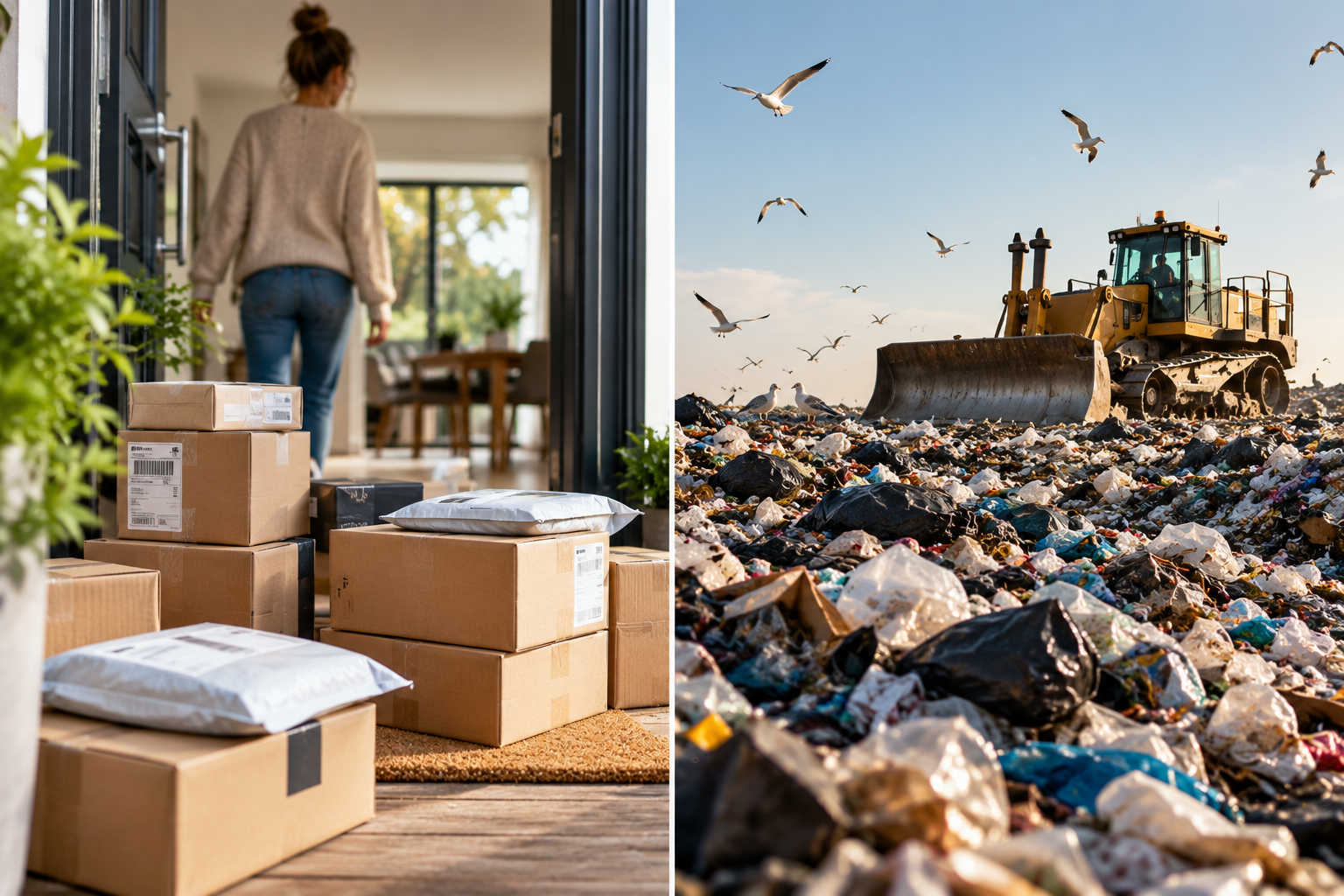
A product can now be discovered on social media, recommended algorithmically, purchased in seconds for a few euros and transported across continents directly to an individual household.
The friction that once existed between wanting something and buying it has almost disappeared.
Textiles provide a striking example.
The latest European Environment Agency data show that textile consumption in the EU increased from approximately 17 kg per person in 2019 to 19 kg in 2022 — roughly a large suitcase of new clothing, footwear and household textiles for every European every year.
At the same time, the EU generated around 6.94 million tonnes of textile waste, or approximately 16 kg per person.
And around 85% of household textile waste was not separately collected, meaning much of it entered mixed waste streams where opportunities for reuse and recycling are lost.
The EEA itself warns about a paradox created by digitalisation: technology can help improve efficiency, but social media and online platforms can simultaneously increase production and consumption.
That is the rebound effect we increasingly need to discuss.
Making shopping more efficient is not necessarily the same as making consumption more sustainable.
The situation is not black and white.
Large platforms are themselves starting to invest heavily in decarbonisation, renewable energy, recycling and logistics efficiency.
SHEIN reports that 76% of the electricity used in its operations came from renewable sources in 2024, and that transport and logistics initiatives helped avoid an estimated 668,800 tonnes of CO₂e.
But its own sustainability reporting also demonstrates the scale problem.
SHEIN reported total Scope 1, 2 and 3 greenhouse-gas emissions of approximately 26.2 million tonnes CO₂e in 2024, compared with about 21.3 million tonnes in 2023 — an increase of roughly 23%. The vast majority came from its value chain rather than its own offices and warehouses.
This illustrates one of the fundamental challenges of the green transition:
a company can become more efficient per product while its overall environmental footprint still grows because the business itself is growing faster.
That distinction between relative improvement and absolute impact is becoming increasingly important.
The same pattern appears in plastics.
Without stronger policies, the OECD projects global plastic use to almost triple by 2060. Plastic waste is expected to almost triple as well, with roughly half still ending up in landfill and less than one fifth being recycled.
Almost two-thirds of plastic waste by 2060 is expected to come from relatively short-lived products such as packaging, inexpensive consumer goods and textiles.
These are exactly the products most closely associated with today's high-volume consumption model.
This is why recycling alone cannot be the answer.
Neither can cleanup alone.
The circular economy is one of the most practical ways to reduce environmental impact: extending product life, repairing, reusing and turning discarded materials into resources rather than waste.
This applies to consumers too. Before asking “Where should I throw this away?”, we should also ask:
Did I need to buy it? Can I use it longer? Can it be repaired, reused or shared?
This is not about stopping consumption. It is about moving from more to better — from disposable to durable, from impulse to intention, and from waste management to resource management.
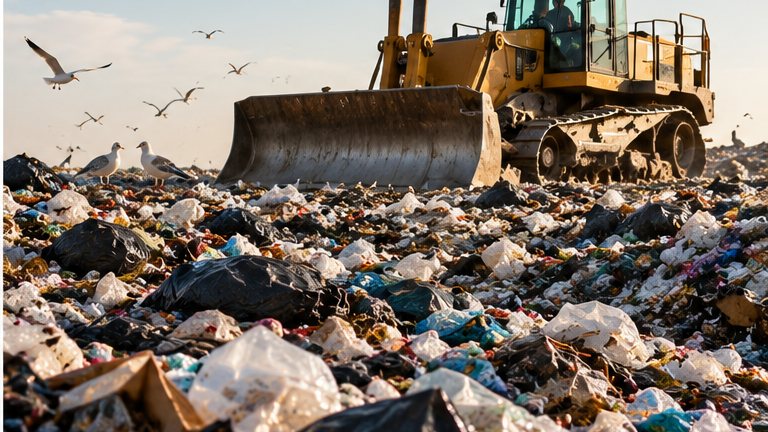
World Cleanup Day makes waste visible — a plastic bottle in a forest, an abandoned tyre or rubbish floating in a river. What is harder to see is the system behind it: extraction, production, packaging, advertising, transportation, purchasing and disposal.
Responsibility therefore cannot rest with consumers alone. Governments, businesses, platforms and brands all shape our choices and must help make sustainable options practical, affordable and accessible.
This September, as millions prepare for World Cleanup Day, we should not only clean up existing waste — we should also prevent the next generation of waste.
Every product requires materials, energy, water, labour, transportation and packaging before someone decides to buy it.
That means one of the most powerful moments in tackling the waste crisis may come just before we press “Buy now.”
Cleanups change places. Changing consumption can change systems. And we need both.
References:
OECD (2024), Monitoring Progress towards a Resource-Efficient and Circular Economy.
OECD (2023), How Green is Household Behaviour? Sustainable Choices in a Time of Interlocking Crises.



.svg)