On 20 September 2026, the United Nations global observance of World Cleanup Day opened in Shaoxing, in China's Zhejiang Province, the first time China hosted it. For three days, more than 800 representatives of governments, cities, international organizations, businesses and academia gathered under the theme "From Clean Plates to Clean Cities", at the invitation of China's Ministry of Housing and Urban-Rural Development, the Zhejiang Provincial People's Government and UN-Habitat.
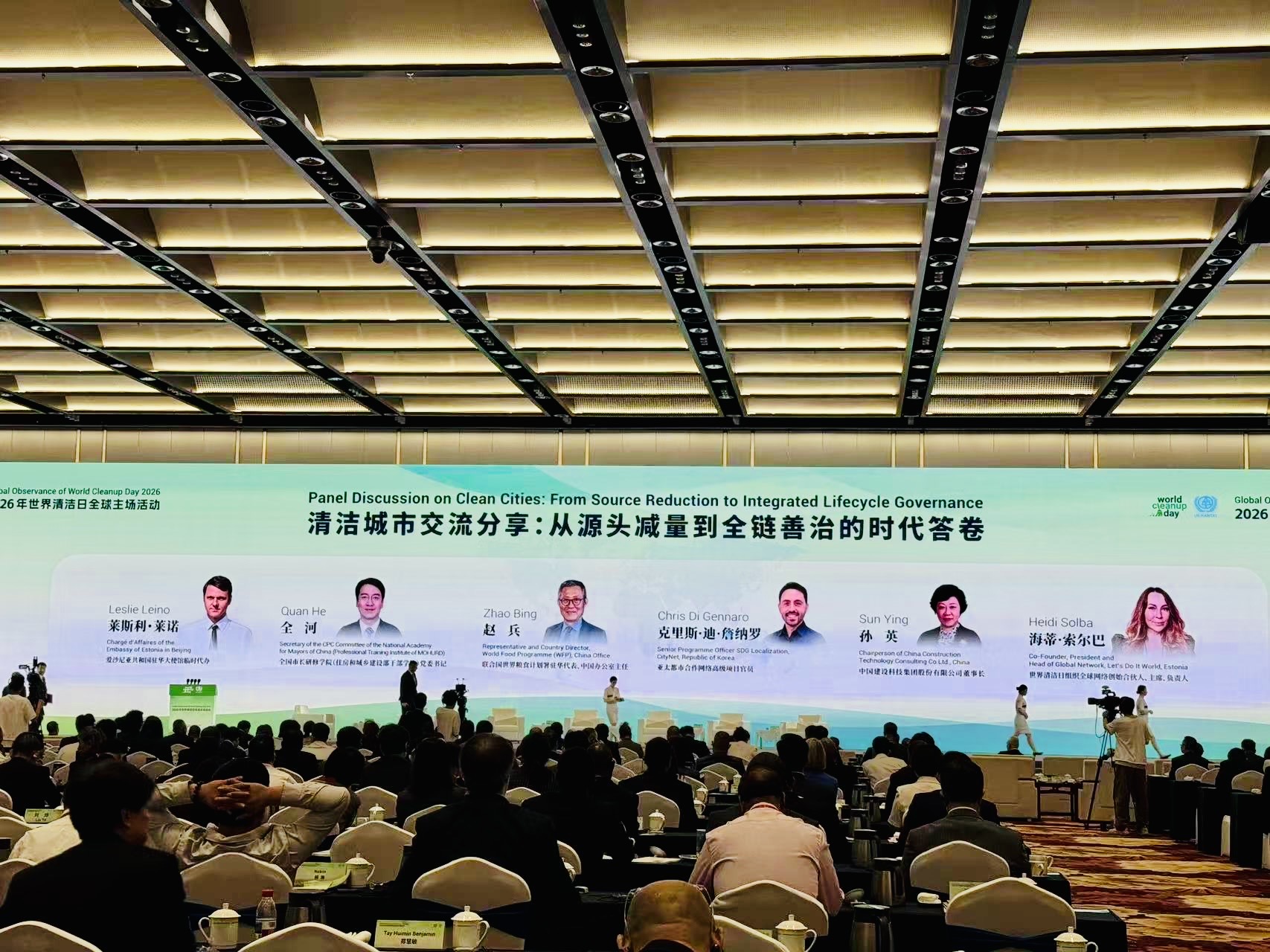

I had the honor of presenting the Let's Do It World movement, which created World Cleanup Day, together with our Board member Pål Mårtensson and our China leader Caicai Wang and her team from Pickup China and I had opportunity to talk in several panel discussions to express the thoughts around the World Cleanup Day. The World Cleanup Day Impact Photo Exhibition filled a large exhibition hall, and World Cleanup Day videos from many countries were shown at the ceremony.
But the most important thing about Shaoxing was not what happened on stage, it is for me the question behind it: how do we make lasting change happen together, and why does it seem so hard today?
World Cleanup Day is not here to celebrate one day. It brings together everyone who holds a piece of the solution: governments who make the rules, cities who run waste systems, businesses who design products, UN agencies who connect countries, and citizens who decide every day what to buy, use and throw away. Each of them can do a great deal alone, but none of them can change the whole system change alone.
And the hardest part of that change is not technical. We know how to build collection systems, how to recycle and how to design out single-use packaging. What we struggle with is changing how millions of people behave, and agreeing on what to do. A law can introduce bins and bans, but it cannot make people care. A policy people do not trust is resisted, ignored or reversed after the next election. The real limit on what governments can solve today is whether people are willing to move in the same direction. That is a question of trust.
The OECD's 2024 Trust Survey across 30 countries found that only 39% of people have high or moderately high trust in their national government. One finding stands out for me: people who feel they have no say in what government does trust it 47 percentage points less than those who feel heard. Trust is not created by messages. It is created by participation, by being part of something and seeing that your action matters. In a world that is becoming more artificial, where so much of what we see is generated rather than lived, that physical, shared experience matters more than ever.
Estonia learned this early. In 2008, 50,000 Estonians cleaned their whole country in a single day. A year later, thousands of people gathered in nationwide think tanks, the "Minu Eesti" (My Estonia) talks, to discuss how to make life in their country better. The cleanup had shown people what they could DO together, and the think tanks turned that energy INTO ideas, motivation and a lasting loyalty to the idea itself. World Cleanup Day repeats this pattern around the world: people come for the cleanup, and they stay because they discover that they can lead change in their own community, and that others will join them.
This is also what makes societies resilient. In a polarized world full of conflict, we usually think of resilience as dams, reserves and emergency plans. Yet the political scientist Daniel Aldrich, studying disasters in Japan, India and the United States, found that the depth of social ties predicted a community's recovery better than wealth, government aid or even the amount of damage. After the 2011 tsunami in Japan, towns where people knew their neighbors had higher survival rates. Aldrich distinguishes bonding ties among people who are alike, bridging ties between people who are different, and linking ties between citizens and those in power. Linking ties matter most for recovery, and they are the first to be destroyed by polarization.
World Cleanup Day builds all three in a single day. Neighbors work side by side; strangers with different views, faiths and politics pick up the same rubbish on the same street; volunteers stand next to mayors, ministers and company leaders, not as petitioners but as partners. Our network has seen this in the hardest places, from the war in Ukraine to the recent floods in Nepal. A cleanup is never only a cleanup - it is a rehearsal for how a society holds together when it matters.
This year we launched Strive for Five, the goal of bringing at least 5% of the world's population into action. Studies of civil resistance have pointed to around 3.5% of a population as the share that can shift what a whole society sees as normal. Our 5% comes from what we have seen in our own movement: when one person in twenty takes part, almost everyone knows someone who did. The action leaves the circle of activists and becomes something "people like us" do. Littering becomes embarrassing, people start to expect better waste services, and politicians notice. Participation turns into expectation, and expectation into policy.
None of this happens in silos. Let's Do It World initiated World Cleanup Day, and its network of national teams organizes the majority of World Cleanup Day actions worldwide. UN-Habitat facilitates the official observance, and governments increasingly host and support it. These are not competing roles but parts of one message. A government campaign without citizens remains a poster; a citizens' movement without institutions remains a single day. When they meet, a day becomes a habit, a habit becomes a norm, and a norm becomes policy.
In a world turning inward, trust needs brokers, and World Cleanup Day is one of them. So, I call for real global cooperation. Governments can recognize the national World Cleanup Day teams of Let's Do It World as partners and include the day in national and city plans. Cities can open their waste systems and data to citizens' action. Businesses can bring their people and their supply chains. The UN family can connect it all. And all of us can share data and stories openly, so that every country learns from every other.
What grows between people when they act together is something no report can fully measure: TRUST. Trust between neighbors, between volunteers and mayors, between civil society, business and government. It is the golden thread running through World Cleanup Day, hidden and invisible to the eye, and the most precious thing our movement creates. As Saint-Exupéry's Little Prince reminds us, the things that matter most cannot be seen with the eyes. Togetherness is one of them, and it is something we can learn.
According to preliminary data, 192 countries and territories have already been reported for World Cleanup Day 2026. Thank you to every leader and volunteer who made 20 September happen in their own community, to every government, city, company, UN-Habitat, the city of Shaoxing for hosting, ministry of Foreign Affairs of Estonia, City of Riga and Latvian Environmental Protection Fund for the support and all organization reading this:
let us stop working in silos and build the next World Cleanup Day together.
See you on 20 September 2027.
Let's do it!